
Recently, a team of scientists from Fudan University's Institute of Modern Physics, Shanghai Nuclear Physics Research Center, and Michigan State University, has made significant progress in theoretical studies of radii of proton-unstable nuclei. The research findings have been published in Physical Review Letters under the title Nuclear Radii of Proton-Unbound Systems (Phys. Rev. Lett. 136, 122501 (2026)).
The size of an atomic nucleus is one of its most fundamental properties, playing a crucial role in understanding essential questions, such as the saturation property of nuclear matter and the limits of nuclear existence. In recent years, the rapid advancement of laser spectroscopy techniques has enabled nuclear physicists to precisely measure the charge radii of nuclei near, and even beyond, the proton drip line. While theoretical calculations of charge radii of stable nuclei are well established, a significant challenge arises for decaying nuclear systems. For unstable nuclei, the radius is not a well-defined observable in the standard quantum mechanical framework. Establishing a direct correspondence between theoretical calculations and experimental measurements requires further developments.
In this study, the team took an innovative approach by combining the complex-energy framework with a real-time evolution method. This allowed them to successfully define a radius for decaying states. The results showed that the radius of an unstable nucleus is complex. The real part of the complex radius represents its expectation value while the imaginary part is the uncertainty associated with the time-dependent decay. The study also revealed an interesting phenomenon near the decay threshold. Here, the real part of the complex radius for valence protons behaves in a nonmonotonic way, which is a signature of a halolike effect. More importantly, the research uncovered an early-time plateau at the very beginning of the decay process, during which the charge radius remains nearly constant. This finding enables theoretical interpretation of future laser spectroscopy experiments of proton-decaying nuclei at radioactive beam facilities.
The first author of the paper is Yaru Lin, a third-year Ph.D. student in our department (supervised by Prof. Simin Wang). The corresponding authors are Prof. Simin Wang from Fudan University and Prof. Witold Nazarewicz from Michigan State University.
Paper link: https://doi.org/10.1103/zz6w-qgrr
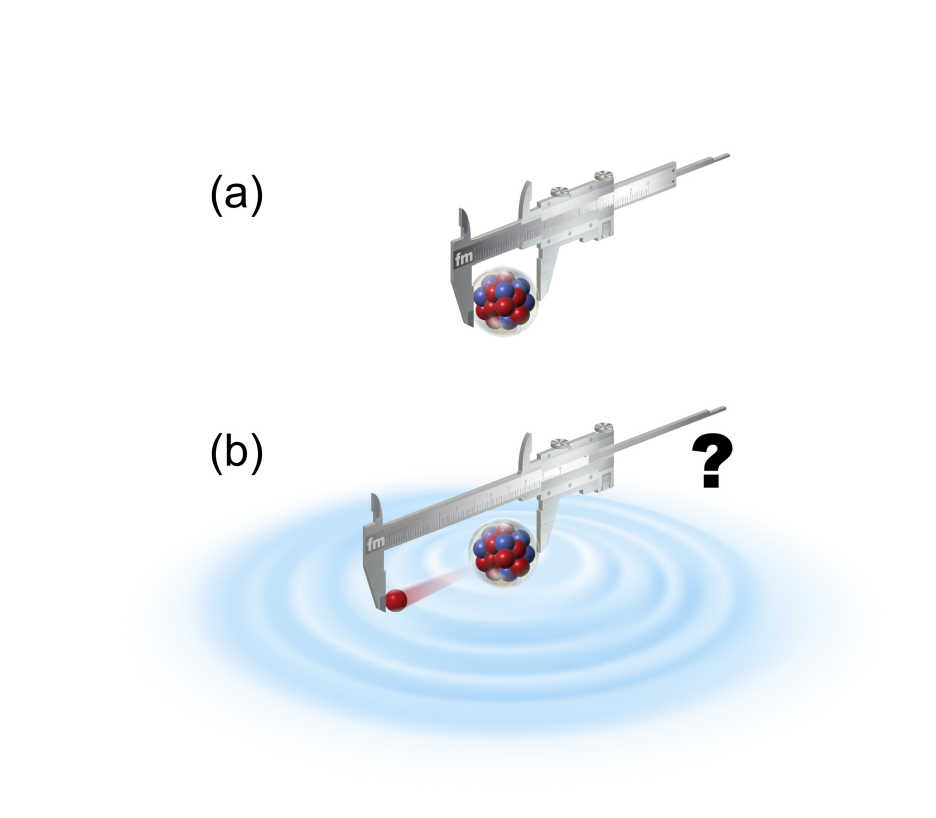
Figure 1. (a) The size of a bound nucleus can be measured by a variety of techniques; (b) For a proton-emitting nucleus, its size can be defined at times shorter than the nuclear half-life when the proton is localized in the nuclear interior.



 联系我们:
联系我们: - 扫码关注 -