
近日,复旦大学现代物理研究所/上海核物理中心研究团队联合美国密歇根州立大学Witold Nazarewicz教授团队在质子滴线外不稳定原子核半径的理论研究中取得重要进展,研究成果以“Nuclear Radii of Proton-Unbound Systems”为题发表在《物理评论快报》(Phys. Rev. Lett. 136, 122501 (2026))上。
原子核的大小是其最基本的性质之一,对核物质的饱和性、原子核的存在极限等一系列根本问题有重要影响。近年来,激光谱学技术的飞速发展使得实验上能够精确测量接近质子滴线甚至跨越滴线的原子核的电荷半径。对于稳定的原子核,其半径的理论计算已经很成熟。但对于不稳定的、会衰变的原子核系统,其半径在传统的量子力学框架下难以被良好定义,理论计算与实验测量之间的直接关联仍需进一步研究。
在该研究中,团队创新性地结合了复能量框架与实时演化方法,成功定义了这类共振态的半径。结果表明,对于不稳定的原子核,其半径可以自然地表示为一个复数,其实部代表半径的期望值,其虚部对应着与含时衰变相关的不确定性。此外,研究发现,在衰变阈值附近,价质子的复半径实部展现出非单调行为(类晕效应)。更重要的是,研究揭示在衰变发生的极早期阶段,系统会存在一个“早期时间平台”。在这一极短的时间窗口内,原子核的电荷半径几乎保持恒定。这一发现为解释未来在放射性束流装置上开展的质子衰变原子核的激光谱学实验提供了关键的理论依据。
论文的第一作者是我系博士三年级研究生林雅茹同学(导师:王思敏研究员)。通讯作者为我系王思敏研究员和美国密歇根州立大学的Witold Nazarewicz教授。
论文链接:https://doi.org/10.1103/zz6w-qgrr
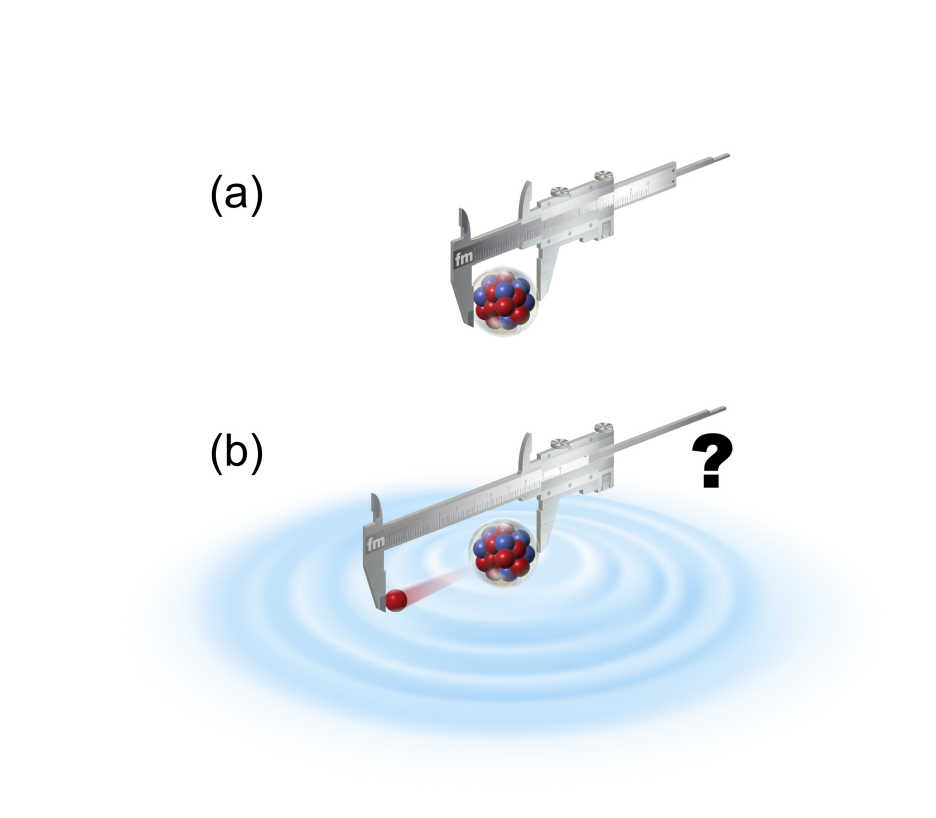
图1. (a)束缚核的半径有完善的定义并可以被多种方式测量(b)非束缚核如何定义和测量半径。

Figure 1. (a) The size of a bound nucleus can be measured by a variety of techniques; (b) For a proton-emitting nucleus, its size can be defined at times shorter than the nuclear half-life when the proton is localized in the nuclear interior.
New Findings on Proton-Unbound Nuclear Radii in PRL
Recently, a team of scientists from Fudan University's Institute of Modern Physics, Shanghai Nuclear Physics Research Center, and Michigan State University, has made significant progress in theoretical studies of radii of proton-unstable nuclei. The research findings have been published in Physical Review Letters under the title "Nuclear Radii of Proton-Unbound Systems" (Phys. Rev. Lett. 136, 122501 (2026)).
The size of an atomic nucleus is one of its most fundamental properties, playing a crucial role in understanding essential questions, such as the saturation property of nuclear matter and the limits of nuclear existence. In recent years, the rapid advancement of laser spectroscopy techniques has enabled nuclear physicists to precisely measure the charge radii of nuclei near, and even beyond, the proton drip line. While theoretical calculations of charge radii of stable nuclei are well established, a significant challenge arises for decaying nuclear systems. For unstable nuclei, the radius is not a well-defined observable in the standard quantum mechanical framework. Establishing a direct correspondence between theoretical calculations and experimental measurements requires further developments.
In this study, the team took an innovative approach by combining the complex-energy framework with a real-time evolution method. This allowed them to successfully define a radius for decaying states. The results showed that the radius of an unstable nucleus is complex. The real part of the complex radius represents its expectation value while the imaginary part is the uncertainty associated with the time-dependent decay. The study also revealed an interesting phenomenon near the decay threshold. Here, the real part of the complex radius for valence protons behaves in a nonmonotonic way, which is a signature of a halolike effect. More importantly, the research uncovered an "early-time plateau" at the very beginning of the decay process, during which the charge radius remains nearly constant. This finding enables theoretical interpretation of future laser spectroscopy experiments of proton-decaying nuclei at radioactive beam facilities.
The first author of the paper is Yaru Lin, a third-year Ph.D. student in our department (supervised by Prof. Simin Wang). The corresponding authors are Prof. Simin Wang from Fudan University and Prof. Witold Nazarewicz from Michigan State University.
Paper link: https://doi.org/10.1103/zz6w-qgrr